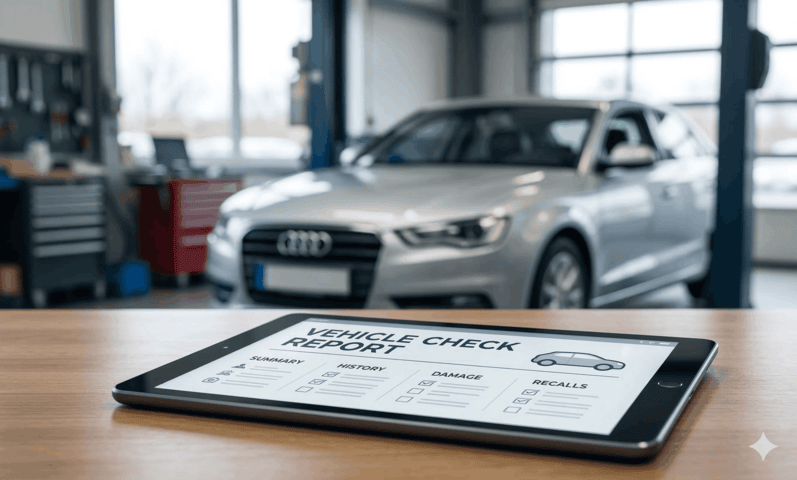
When buying a used car, the most expensive problems are often the ones you cannot see. A vehicle check report helps you validate key signals: VRM/VIN consistency, V5C (logbook) issue date, outstanding finance (HP/PCP), theft markers, mileage consistency and salvage/insurance records.
- What a vehicle check report is (and what it isn’t)
- What’s typically inside a report
- How to interpret common risk signals
- How to use reports to make better decisions
What does a vehicle check report include?
A good report is designed to answer a simple question: “Is the car really what the advert claims?” In the UK, reports commonly cover the areas below.
1) Identity & registration checks (VRM / VIN / V5C)
The registration mark (VRM) and the Vehicle Identification Number (VIN) should match the underlying records. A mismatch can indicate an incorrect advert, plate transfer confusion, or more serious identity issues. The V5C issue date helps you understand the administrative history.
2) Damage, salvage and insurance markers
Accident/insurance records, salvage categories and auction markers can materially affect value and insurability. If the vehicle is marked as scrapped or has a Certificate of Destruction, you should not proceed without verifying official documentation.
3) Mileage consistency
Mileage should be consistent with MOT and service history. Inconsistencies can happen due to data gaps, instrument cluster changes, or tampering. Treat it as a prompt to verify supporting evidence.
4) Outstanding finance (HP / PCP / lease)
If a vehicle is subject to finance, a buyer could inherit risk. Ask the seller for written proof that finance has been settled and cross-check it with the report.
5) Theft & high-risk indicators
If there is a theft marker or a high-risk/interest flag, validate via official channels and request documentation before committing to purchase.
Quick used car checklist (UK)
How to read a vehicle check report (step-by-step)
Most buyers skim a report and look for a single “pass/fail” indicator. In practice, reports work best when you treat them like an evidence pack. Use the steps below to interpret results and decide what to verify next.
Step 1: Confirm identity first
Start with VRM and VIN, then confirm the car details (make, model, colour and year). If any key identity fields look wrong, stop and ask the seller to explain before you spend time on the rest of the report.
Step 2: Check the V5C logbook issue date and keeper story
The V5C issue date can indicate changes in registration details. It does not automatically mean a problem, but it can be a reason to ask follow-up questions. If the seller claims “one careful owner” but the paperwork suggests frequent changes, that mismatch is a negotiation and risk signal.
Step 3: Prioritise finance and theft markers
Outstanding finance (HP/PCP/lease) and theft markers are high-impact outcomes. If either appears, you should not rely on verbal reassurance. Ask for settlement proof and, where possible, verify with the finance provider.
Step 4: Build a mileage timeline
Look for a consistent progression across MOT and service points rather than focusing on a single reading. A gap is not always fraud, but it is a prompt to request additional invoices, old MOT certificates, or maintenance records.
Step 5: Interpret damage and salvage markers in context
Insurance and salvage data can affect resale value, insurance premiums and safety. If there is any indication of a total loss, structural repair or scrappage, ask for photographic evidence of repairs, invoices and a professional inspection.
Common red flags (and what to do next)
A report rarely tells you to “walk away” by itself. The practical approach is to translate each risk into a next step.
Documents to check with the seller
A vehicle report is strongest when it matches physical documents. Before you buy, ask for the items below and compare them to the report details.
- V5C logbook (check issue date, VIN and keeper details)
- MOT history and recent certificates
- Service history (stamps, invoices and major maintenance items)
- Finance settlement letter (if the car has ever been on HP/PCP)
- Receipts for repairs (especially after any accident)
Where does the data come from?
UK vehicle reporting typically combines multiple sources. You may see DVLA registration details, DVSA MOT records, finance registers and insurance-related signals. Different datasets update on different timelines, so treat the report as a current snapshot and always verify anything critical with paperwork.
FAQs
Is a vehicle check report enough on its own?
Not on its own. A report is ideal for spotting risk quickly, but you should also do a test drive, verify documents and consider an independent inspection.
What should I do if finance is recorded?
Ask the seller for written confirmation that finance has been settled and, where possible, verify with the finance provider.
Can I use a report to negotiate the price?
Yes. A report can justify a fair adjustment if it reveals non-obvious issues (damage history, missing records, inconsistencies). Always document your reasoning and be clear about what you still need to verify.
What if the seller refuses to share documents?
Treat it as a risk signal. Genuine sellers typically have no problem showing the V5C, MOT history and service evidence. If they will not cooperate, it may be safer to walk away.
Which checks should I do first if I’m short on time?
Prioritise identity (VRM/VIN), finance and theft checks first. Then validate mileage consistency and any salvage or insurance markers before arranging a professional inspection.