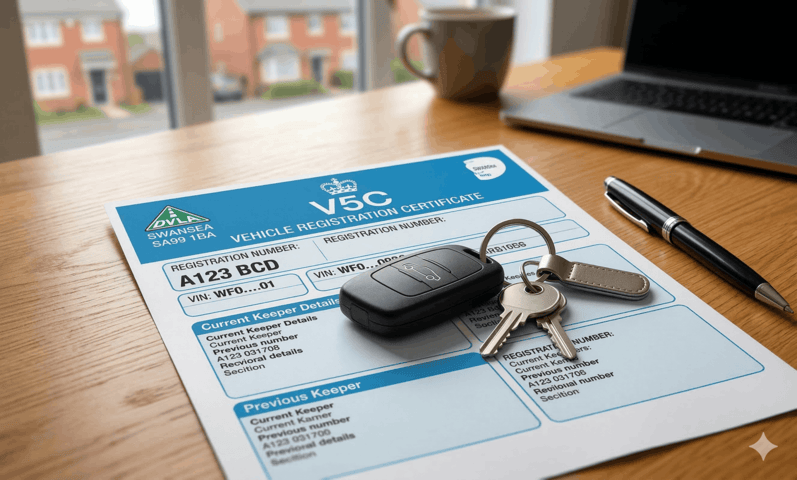
The V5C logbook (vehicle registration certificate) is one of the most important documents you should see before paying for a used car in the UK. A V5C is not proof of ownership, but it helps you confirm identity details, keeper information, and whether the story matches the advert.
- What a V5C tells you (and what it doesn’t)
- Step-by-step V5C checklist
- Common red flags and next actions
- How to pair the V5C with a vehicle check report
What the V5C logbook confirms
Use the V5C to validate key details like the vehicle’s VIN (chassis number), registration mark (VRM), make/model, colour and fuel type. It also shows registered keeper details and a document issue date. If the V5C details don’t match the car and the seller’s story, treat it as a risk signal.
What the V5C does not prove
The V5C is often misunderstood. It does not guarantee the car is free from finance, it does not confirm the car has never been stolen, and it does not prove the seller legally owns the vehicle. Think of it as an identity and registration document that must be consistent with the car, the seller’s ID, and the rest of the evidence.
Where to find the VIN on the vehicle
Before you compare the VIN to the V5C, locate it on the car itself. Different manufacturers place VIN identifiers in different locations, but the common areas below are worth checking.
- At the base of the windscreen (often on the driver’s side)
- Door shut / B-pillar sticker or plate (driver’s side)
- Engine bay stamping or VIN plate
- Under a seat or in the boot floor (less common)
If you see signs of tampering around VIN locations (fresh rivets, damaged stickers, scratched metal), pause the purchase and verify through official channels.
V5C logbook checklist (before you buy)
A simple verification flow (10-minute check)
If you want a fast but sensible approach, use this order. It reduces the chance of getting distracted by minor details while missing the big risks.
- Confirm the seller’s identity and that the seller’s story makes sense for the vehicle.
- Match VRM on the car to the advert and V5C.
- Locate VIN on the vehicle and match it to the V5C.
- Check the V5C issue date and ask why it was re-issued if it is recent.
- Run a vehicle check report to screen for finance/theft/mileage/salvage indicators.
- Only then discuss payment and handover.
Buying from a dealer vs private seller
Your V5C checks should be similar in both cases, but the risk profile and “next steps” differ. With a private sale, you rely more on the seller’s documentation and transparency. With a dealer, you should still check identity and consistency, but also expect invoices, warranty terms and a clear returns policy.
- Verify the seller is linked to the keeper story
- Ask for service invoices and MOT evidence
- Be cautious with deposits and remote payments
- Confirm the invoice matches vehicle identity (VIN/VRM)
- Read warranty terms and what is excluded
- Ensure paperwork and handover process is clear
Red flags to watch for
A single mismatch does not always mean a scam, but patterns matter. Treat the items below as prompts to slow down and verify.
Payment and handover checklist
Once paperwork is consistent, keep the final stage controlled. The goal is to avoid situations where you have paid but cannot complete a safe handover.
- Confirm you have seen the V5C and matched VIN/VRM before paying a deposit.
- Keep written confirmation of what is included (spare keys, service book, locking wheel nut, accessories).
- If finance was ever present, request written settlement proof and verify where possible.
- Only complete payment when you can take the vehicle and keys immediately.
Pair the V5C with a vehicle check report
The V5C is most useful when it matches external checks. A vehicle check report helps you screen for finance, theft markers, mileage consistency and salvage signals. Use the V5C to confirm identity, then use the report to validate risk areas that are not visible in the logbook.
When time is limited, prioritise your V5C document checks in this order:
- VIN and VRM match — Compare the V5C to the physical VIN plate on the vehicle. A mismatch is a deal-breaker.
- Registered keeper details — Does the seller's name and address match the V5C? If not, ask why and verify their identity.
- Document issue date — A very recent V5C on an older car can indicate a recent change of keeper or a replacement document — both warrant further questions.
- Number of previous keepers — High turnover in a short period can signal recurring problems.
- Vehicle colour and engine size — Make sure these match the actual vehicle in front of you.
After confirming document consistency, run a vehicle history check to uncover issues that the V5C alone cannot reveal: outstanding finance, theft markers, write-off history and mileage discrepancies.
FAQs
Is the V5C proof of ownership?
No. The V5C shows the registered keeper, not legal ownership. You still need to verify the seller’s identity and paperwork.
Should I avoid a car with a recently issued V5C?
Not necessarily. It can be normal after address changes or admin updates. Treat it as a reason to ask questions and confirm details.
What should I do if the seller is not the registered keeper?
Be cautious. Ask for a clear explanation and evidence that the seller is authorised to sell the car.
Can a V5C be fake?
It can be forged. That’s why you should match VIN/VRM to the physical car, check for inconsistencies, and use a vehicle report to validate key risks like theft and finance.
Should I send a deposit before seeing the V5C?
If you cannot verify identity and documents, a deposit increases your risk. A safer approach is to verify VIN/VRM and paperwork first, then proceed with payment during a controlled handover.