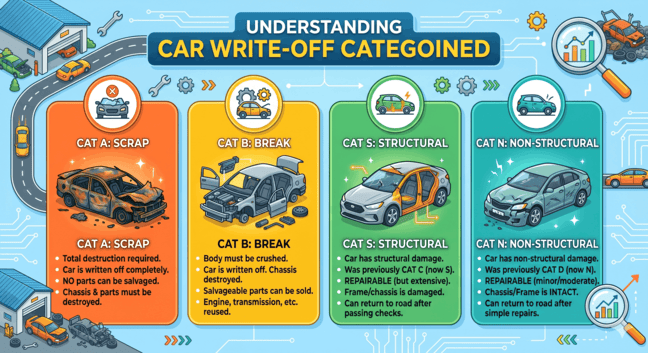
When a UK insurer decides a damaged vehicle isn't economically viable to repair under the policy, they "write it off" and assign a category. Since October 2017, the UK uses four categories: A, B, S and N. The category determines whether the vehicle can ever return to the road.
- The four UK write-off categories (A, B, S, N)
- Old vs new category system
- Should you buy a write-off?
- How write-offs appear on a vehicle check
- Frequently asked questions
The four UK write-off categories
Since October 2017, the Association of British Insurers (ABI) classifies written-off vehicles into four categories. The first two (A and B) mean the vehicle must never return to the road. The other two (S and N) mean the vehicle can be repaired and re-registered.
Category A — Scrap only
Category A is the most severe classification. The entire vehicle must be crushed — no parts can be salvaged or resold. This category is typically applied after extreme fire damage, severe flood damage, or catastrophic structural failure that makes every component unsafe. A Category A vehicle cannot be re-registered and should never appear for sale as a whole vehicle or as parts.
Category B — Break for parts
The body shell must be crushed, but salvageable parts (engine, gearbox, electronics, trim) can be removed and resold individually. Category B is used when the vehicle's structure is too damaged to repair safely, but some mechanical or cosmetic components remain usable. Like Category A, a Cat B vehicle cannot be re-registered as a whole vehicle and should never be offered for sale as a driveable car.
Category S — Structural damage, repairable
Previously known as "Category C" under the old system, Category S indicates the vehicle has sustained structural damage — to the chassis, crumple zones, pillars or other load-bearing elements — but can be professionally repaired and returned to the road. Before re-registration, a Cat S vehicle must pass a Vehicle Identity Check (VIC) or equivalent inspection to confirm it is roadworthy and its identity has not been altered. Category S is one of the most common write-off categories that buyers encounter on the used market.
Category N — Non-structural damage, repairable
Previously known as "Category D", Category N covers vehicles with non-structural damage — for example, body panels, bumpers, electronics, or engine and gearbox faults. The key distinction is that no structural or load-bearing components have been affected. A Cat N vehicle can be repaired and returned to the road without a mandatory re-inspection, although an independent inspection is strongly recommended before purchase. Category N is the most common write-off category overall, as even relatively minor damage can be uneconomical for an insurer to repair under the terms of the policy.
| Category | Damage type | Can return to road? | Re-inspection required? |
|---|---|---|---|
| Cat A | Total loss — scrap only | No | N/A |
| Cat B | Break for parts only | No | N/A |
| Cat S | Structural damage (repairable) | Yes | Yes (DVLA re-registration) |
| Cat N | Non-structural damage (repairable) | Yes | No (but recommended) |
Old vs new category system
Before October 2017, the UK used Categories A, B, C and D. The system was updated to make the classification clearer and more directly linked to the type of damage rather than just the economics of repair.
Should you buy a write-off?
Category S and N vehicles are legal to buy and sell in the UK, and they can represent good value — typically 20–40% cheaper than equivalent cars with no write-off history. However, the savings come with real risks that you need to manage carefully.
Potential benefits
- Significant price reduction compared to equivalent non-written-off vehicles
- A well-repaired Cat S or Cat N car can be perfectly safe and reliable
- If you plan to keep the car long-term, the lower resale value matters less
Key risks
Essential checks before buying a write-off
If you see a Cat A or Cat B car advertised as a whole, driveable vehicle, walk away immediately. It is illegal to put these back on the road, and selling them as complete cars is a serious red flag for fraud.
How write-offs appear on a vehicle check
Write-off markers on a vehicle history report come from the Motor Insurance Anti-Fraud and Theft Register (MIAFTR) database, which is maintained by the insurance industry. When an insurer writes off a vehicle, the record is added to this database and becomes visible on vehicle check reports.
A typical vehicle history report will show the write-off category (A, B, S or N), the date the write-off was recorded, and sometimes the insurer involved. This information is permanent — even after a Cat S or Cat N vehicle has been repaired and returned to the road, the write-off marker remains on its record.
Important caveat: not all damage is reported. If a vehicle was damaged and repaired privately without an insurance claim being made, there will be no write-off marker on the record. This is why a clean vehicle history report should always be combined with a physical inspection — the absence of a marker does not guarantee the car has never been damaged.
FAQs
Can I insure a Cat S or Cat N car?
Yes, most UK insurers will cover Cat S and Cat N vehicles, but premiums may be higher than for an equivalent car with no write-off history. A small number of insurers refuse to cover previously written-off cars, so it is worth getting insurance quotes before you commit to buying.
Does a write-off marker ever get removed?
No. Once a vehicle has been recorded as a write-off on the MIAFTR database, the marker is permanent. Even if the car has been professionally repaired and is in excellent condition, the write-off history will always appear on vehicle check reports.
What is the difference between Cat S and Cat N?
Category S means the vehicle has structural damage (chassis, crumple zones, pillars), while Category N means the damage is non-structural (panels, bumpers, electrics, mechanical). Both can be repaired and returned to the road, but Cat S vehicles must pass a re-inspection before re-registration.
How much cheaper are written-off cars?
Cat S and Cat N cars are typically 20–40% cheaper than equivalent vehicles with no write-off history. The exact discount depends on the age, make, model and the severity of the original damage. The discount tends to be larger for Cat S (structural) than Cat N (non-structural).
Can I check if a car is a write-off for free?
Basic vehicle checks may not include write-off data. A comprehensive vehicle history report, such as those from CarCheckReport, queries the MIAFTR database and will show whether a write-off marker exists, along with the category and date. This is one of the most important checks you can run before buying a used car.