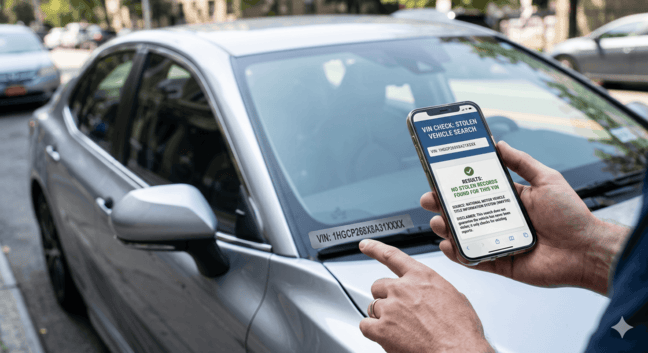
In the UK, stolen vehicle markers are held on the Police National Computer (PNC). A vehicle history check queries this database and flags any active theft markers against the registration. If you buy a stolen car — even unknowingly — the police can seize it, and you'll lose both the car and your money.
- How stolen car data works in the UK
- Warning signs the car might be stolen
- How to check for theft markers step by step
- What to do if you suspect a car is stolen
- Your legal position as a buyer
How stolen car data works in the UK
When a vehicle is reported stolen in the UK, the police log the details on the Police National Computer (PNC). This is the central database used by every police force in England, Wales, Scotland and Northern Ireland to track stolen property, including vehicles. The PNC record is linked to the vehicle's registration number and VIN.
The PNC is not publicly searchable. Members of the public cannot log in and check it directly. Instead, you need to use a vehicle history check service that has authorised access to query PNC stolen vehicle data on your behalf. This is a key reason why running a proper vehicle check matters — it is the only practical way for a buyer to see whether a theft marker exists.
It is important to understand that the DVLA does not hold theft data. The DVLA maintains registration and keeper records, but it does not record whether a vehicle has been reported stolen. Only the police (via the PNC) hold that information.
On the roads, police use Automatic Number Plate Recognition (ANPR) cameras that continuously scan passing vehicles and cross-reference registration plates against PNC records in real time. If a stolen vehicle passes an ANPR camera, it triggers an alert for officers to intercept.
"Stolen and recovered" vs. active theft marker
There is an important distinction between two types of PNC record. An active theft marker means the vehicle is currently recorded as stolen and has not been recovered — purchasing it is illegal, and the police will seize it on sight. A "stolen and recovered" marker means the car was previously reported stolen but has since been found and returned. The active theft flag is removed, but a historical record remains. A stolen-and-recovered marker is not necessarily a dealbreaker, but you should ask why the car was stolen, whether it was damaged, and confirm with the insurer or police that the case is fully closed.
Warning signs the car might be stolen
Before you even run a vehicle check, there are physical and situational warning signs that should raise suspicion. If you notice any of the following during a viewing, proceed with extreme caution.
How to check for theft markers
Follow these steps before handing over any money. A systematic approach significantly reduces your risk of buying a stolen vehicle.
What to do if you suspect a car is stolen
If warning signs emerge during a viewing or after running a check, your safety comes first. Follow these steps carefully.
Your legal position
UK law is clear on this subject, and it is important to understand your rights and obligations before buying any used car privately.
Under the Theft Act 1968, receiving stolen goods is a criminal offence if you know or believe them to be stolen. Even handling goods while being reckless as to whether they are stolen can lead to prosecution.
However, even if you buy a stolen car in complete good faith — with no knowledge whatsoever that it was stolen — you do not acquire legal ownership. The car still belongs to the original owner, or more commonly their insurer (if the theft was claimed on insurance). The police have the authority to seize it and return it to the rightful owner, leaving you out of pocket.
Your only remedy in this situation is to pursue the seller through the civil courts to recover the money you paid. In practice, this can be difficult — particularly if the seller used a false identity or cannot be traced. This is precisely why running a stolen vehicle check before you buy is so important: it is far easier to avoid the problem than to fix it afterwards.
FAQs
Can I check if a car is stolen for free?
The free DVLA vehicle enquiry service on GOV.UK confirms basic registration details (make, model, colour, tax and MOT status) but does not include PNC stolen vehicle data. To check for active theft markers, you need a vehicle history check from a service that queries the Police National Computer.
What happens if I unknowingly buy a stolen car?
The police can seize the vehicle at any time and return it to the legal owner (or their insurer). You will lose the car and the money you paid. You would need to pursue the seller through civil courts for compensation, which can be difficult if they used a false identity.
How quickly does a stolen car appear on the PNC?
When a theft is reported to the police, the vehicle is usually added to the PNC within hours. However, the exact timing depends on the police force processing the report. A vehicle check will only show data that has been recorded at the time of the query, so if a car was stolen very recently, there may be a brief delay before it appears.
Is it safe to buy a car with a "stolen and recovered" marker?
A stolen-and-recovered marker means the car was previously stolen but has been found and the active theft flag removed. It is not automatically a reason to walk away, but you should investigate further: ask for proof that the case is closed, check for damage that may have occurred while it was stolen, and confirm the insurer has released any claim on the vehicle.
Does a vehicle check guarantee the car isn't stolen?
A vehicle check queries the PNC at the time you run it and reports what is currently on record. It cannot guarantee future events or cover cases where a theft has not yet been reported. However, it is the most practical and effective tool available to private buyers for identifying stolen vehicles before purchase.