Buying a used car in the UK requires checking more than just the engine and tyres. Before you hand over any money, you should verify the vehicle's legal status, ownership history, outstanding finance, MOT record, and physical condition. This checklist covers every step — from online research to the test drive and final handover.
- Before the viewing — online checks
- At the viewing — document checks
- At the viewing — physical inspection
- The test drive
- Buying from a dealer vs private seller
- Payment and handover
- FAQs
Before the viewing (online checks)
Do your homework before you travel to see the car. Online checks are free or low-cost and can save you a wasted journey — or worse, a costly mistake.
At the viewing (document checks)
Before you inspect the car itself, ask to see the paperwork. Legitimate sellers will have documents ready — reluctance to show them is a warning sign.
At the viewing (physical inspection)
Try to view the car in daylight and on dry ground. Rain and poor lighting can hide bodywork defects, rust and paint inconsistencies.
Bodywork
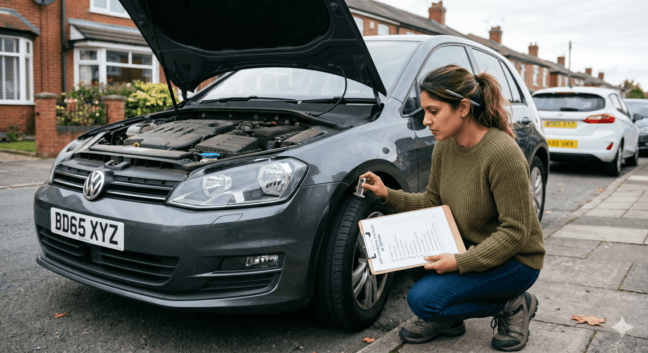
Walk around the car and check panel gaps — they should be even on both sides. Look for paint colour differences between panels, which can indicate accident repair. Run your hand along panels to feel for filler or rippling. A small magnet will not stick to areas where body filler has been used, which is a quick way to detect hidden repairs.
Tyres
The legal minimum tread depth in the UK is 1.6mm across the central three-quarters of the tread width, around the entire circumference of the tyre. Check all four tyres plus the spare (if fitted). Uneven wear across a tyre can indicate wheel alignment problems or worn suspension components. Mismatched tyre brands on the same axle are not illegal but may suggest budget maintenance.
Engine
Ask to start the car from cold if possible — problems are easier to detect before the engine warms up. Listen for knocking, rattling or tapping sounds. Watch the exhaust: blue smoke suggests oil burning, white smoke can indicate a head gasket issue, and black smoke points to a fuelling problem. Check the oil level and condition on the dipstick — it should be between the min and max marks and not appear milky (which could indicate coolant contamination).
Interior
Test all electronics: electric windows, central locking, air conditioning (both hot and cold), heated seats, infotainment system and Bluetooth. Check the dashboard for warning lights — with the ignition on, all lights should illuminate briefly, then clear once the engine is running. Any that remain lit indicate a fault.
Underneath the car
Look underneath for rust on the sills, subframe and floor pans. Check the condition of the exhaust system — heavy corrosion or patches suggest it may need replacing soon. Look for oil or fluid leaks on the ground beneath the engine and gearbox. If you are not confident inspecting underneath, consider paying for a professional pre-purchase inspection.
The test drive
A test drive is not optional — it is essential. Aim for at least 15 to 20 minutes and try to include a mix of road types: town driving, faster A-roads or dual carriageways, and some hills if possible.
Buying from a dealer vs private seller
Your legal rights differ significantly depending on who you buy from. Understanding these differences before you commit is essential.
Dealer
The Consumer Rights Act 2015 applies when you buy from a trader. The car must be of satisfactory quality, fit for purpose, and as described. If the car develops a fault within 30 days of purchase, you have the right to reject it for a full refund. After 30 days but within six months, the dealer must be given one opportunity to repair or replace the vehicle. If the repair fails, you can request a refund (which may be reduced for use). These protections apply whether you buy from a franchised dealer, an independent garage, or an online trader.
Private seller
Private sales are covered by the Consumer Rights Act only in limited ways — primarily, the car must be "as described." The principle of "buyer beware" (caveat emptor) largely applies. The car does not need to be of satisfactory quality or fit for purpose. This is why thorough pre-purchase checks are even more critical when buying privately. If the seller misrepresents the car (for example, claiming it has never been in an accident when it has), you may have a claim under the Misrepresentation Act 1967.
Auction
Cars sold at auction are typically sold "as seen" with minimal legal protection. You usually cannot test drive the vehicle, and inspection time is limited. Auction purchases are generally suited to experienced buyers who can assess risk quickly. Always read the auction house terms and conditions before bidding.
Payment and handover
Once you are satisfied the car is sound and the price is agreed, follow these steps to complete the purchase safely.
- Never pay by bank transfer before seeing the car. Scammers often request payment in advance and then disappear. If you must transfer funds, do so only after inspecting the vehicle in person and verifying the seller's identity.
- Get a receipt. It should include the seller's full name and address, the vehicle registration, make, model, VIN, mileage at sale, the agreed price, and the date. Both parties should sign it.
- Complete the V5C. The seller fills in the green "new keeper" slip (section 6) and gives it to you. The seller then sends the rest of the V5C to the DVLA. You should receive your own V5C in the post within four to six weeks.
- Arrange insurance before driving away. It is illegal to drive without at least third-party insurance in the UK. Many insurers allow you to set up a policy by phone or online within minutes.
- Collect everything. Confirm you have both keys, the locking wheel nut key (if applicable), the owner's handbook, any service books, and the MOT certificate if available.
FAQs
Do I need a vehicle history check if I am buying from a dealer?
Yes. While dealers have legal obligations under the Consumer Rights Act 2015, a history check can reveal issues the dealer may not be aware of — or may not have disclosed. Outstanding finance, for example, remains attached to the vehicle regardless of who sells it.
What is the legal minimum tyre tread depth in the UK?
The legal minimum is 1.6mm across the central three-quarters of the tread width, around the entire circumference of the tyre. Driving with tyres below this limit is an MOT failure and carries a fine of up to £2,500 and three penalty points per tyre.
Can I return a used car bought privately if it has a fault?
Private sales offer limited protection. The car must be "as described," but the seller is not required to guarantee quality or fitness for purpose. If the seller actively misrepresented the car, you may have a claim under the Misrepresentation Act 1967, but enforcement can be difficult and may require a court claim.
Should I pay cash or use a finance agreement?
If you pay by credit card for any amount between £100 and £30,000, you gain additional protection under Section 75 of the Consumer Credit Act 1974. The credit card company is jointly liable with the seller. This applies even if you only pay a deposit on the card. Bank transfers offer no equivalent protection.
How do I check if a car has outstanding finance?
Run a vehicle history check using the registration number. Reputable check providers query finance databases to flag HP, PCP or lease agreements still registered against the vehicle. If finance is recorded, do not proceed until the seller provides a written settlement letter from the finance company.